
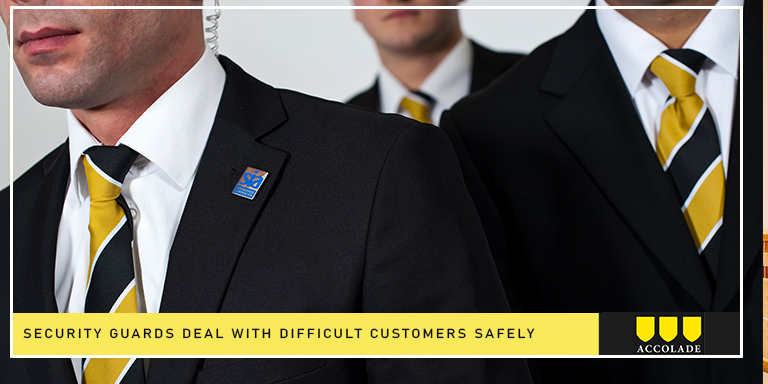
How security guards deal with difficult customers Safely
The Professional Approach to Managing Confrontation
Knowing how security guards deal with difficult customers safely is essential for any London business that serves the public. Trained, SIA-licensed security officers use a structured combination of verbal de-escalation, situational awareness, controlled positioning, and clear communication to manage confrontational individuals without escalating the situation further. The goal is always to protect staff, other customers, and the individual involved — while keeping the business running smoothly. Across retail stores on Oxford Street, hotels in Westminster, licensed venues in Camden, and corporate lobbies in the City of London, the ability to resolve hostile encounters safely defines the difference between professional security and a simple uniformed presence.
Why This Matters for London Businesses
Difficult customer interactions are not rare events. They happen daily across London’s retail, hospitality, and leisure sectors. An intoxicated guest in a hotel lobby, a shoplifter confronted at the exit, an aggressive individual at a reception desk, or a disruptive attendee at a corporate event — each situation carries real risks.
Handled poorly, these encounters can result in physical harm to staff or bystanders, legal liability for the business, reputational damage, and operational disruption. Handled well, they protect everyone on site and reinforce confidence among employees and visitors alike.
Professional security is not only about presence. It is about risk assessment, prevention, communication, response, and consistent site supervision. This principle applies directly to managing confrontational individuals professionally — the security officer’s conduct in a tense moment shapes the outcome for everyone involved.
Step-by-Step: How Trained Security Officers Defuse Tense Situations
Effective conflict de-escalation follows a repeatable process that SIA-licensed security officers are trained to apply. Here is how it works in practice.
Step 1: Observe and Assess Before Approaching
Before engaging, a skilled security officer reads the situation. They assess body language, voice tone, the number of people involved, potential weapons or hazards, and available exit routes. This brief assessment — often taking just seconds — determines whether the situation requires calm verbal engagement, a request for backup, or an immediate call to the police.
Step 2: Create a Calm, Non-Threatening Presence
Officers position themselves at a safe distance, maintain open body language, and avoid crossing their arms or pointing. The aim is to lower tension rather than amplify it. In retail security settings, this might mean stepping slightly to the side of an agitated customer rather than blocking their path.
Step 3: Use Verbal De-Escalation Techniques
Trained officers speak in a steady, measured tone. They use the person’s name if known, acknowledge feelings without agreeing with aggressive behaviour, and offer clear, simple choices. Phrases such as “I understand you’re frustrated — let me see how we can resolve this” are far more effective than commands or ultimatums.
Step 4: Set Clear Boundaries
If verbal de-escalation does not resolve the situation, officers communicate firm, professional boundaries. They explain what behaviour is unacceptable and what the consequences will be — such as being asked to leave the premises. Boundaries must be delivered calmly and consistently.
Step 5: Escalate When Necessary
When a situation involves physical threat, a weapon, or refusal to leave, officers follow their site-specific escalation procedures. This may involve calling the police, activating CCTV monitoring to record the incident, or requesting support from a supervisor. Physical intervention is always a last resort, used only in proportion to the threat and within the legal framework.
Step 6: Document and Report
Every significant interaction must be logged. Detailed incident reporting protects the business legally, supports any police follow-up, and helps the security provider identify patterns. Proper documentation is a hallmark of professionally managed security operations.
How Handling Differs Across Security Environments
What London businesses often overlook is that managing unruly visitors at business premises requires different approaches depending on the setting.
- Retail stores — Loss prevention officers must balance confrontation with customer experience. Detaining a suspected shoplifter requires specific legal knowledge around reasonable force and citizen’s arrest.
- Hotels and hospitality — Hotel security officers handle intoxicated guests, domestic disputes, and unauthorised room access. Discretion and guest dignity are paramount in these settings.
- Licensed venues and bars — Door supervisors routinely manage aggressive behaviour linked to alcohol. They control entry, refuse admission, and remove individuals while complying with licensing conditions.
- Corporate offices — Corporate security officers manage disgruntled visitors, terminated employees returning to premises, and access control breaches. A composed, low-profile response protects both the individual and the business environment.
- Events and festivals — Event security staff handle crowd-related tensions, gate-crashers, and disputes between attendees, often in high-energy environments where situations can change rapidly.
Each environment demands tailored site instructions, and this is why a proper risk assessment before deployment is non-negotiable.
Common Mistakes to Avoid
- Deploying officers without site-specific briefings. An SIA licence confirms baseline competence, but without understanding the venue layout, escalation contacts, and house rules, even a licensed officer will underperform.
- Relying on physical presence alone. Standing at a door without active observation skills or communication training does not prevent incidents — it simply delays them.
- Failing to document incidents. Businesses that do not insist on written incident logs lose the evidential record that protects them in complaints, insurance claims, and legal proceedings.
- Choosing security providers without ACS accreditation. The SIA Approved Contractor Scheme provides independent assurance that a company meets audited standards for training, supervision, and operational management. Providers without this accreditation may lack the systems needed to support their officers on the ground.
- Ignoring post-incident review. Every serious interaction should feed back into the security plan. What triggered the situation? Could it have been prevented? Should staffing, positioning, or access control be adjusted?
Expert Insight: Why Communication Outperforms Confrontation
Across the UK private security industry, the most effective officers are not the most physically imposing — they are the best communicators. Security incident management in London increasingly depends on verbal skills, emotional intelligence, and the ability to read a situation before it becomes critical.
The Security Industry Authority (SIA) includes conflict management as a mandatory element of door supervisor and security guard training. However, SIA trained customer handling at the licensing level covers fundamentals. Experienced providers like Accolade Security — an ACS-accredited company with over 20 years of operational experience — supplement this with ongoing training, site-specific coaching, and management oversight from an IOSH-qualified team that conducts regular site supervision and risk assessments.
Key Takeaways
- Trained security officers use a structured de-escalation process — observe, engage calmly, set boundaries, and escalate only when necessary.
- Verbal communication and emotional intelligence resolve most difficult customer situations without physical intervention.
- Incident documentation protects the business and supports continuous improvement.
- Security needs differ significantly across retail, hotel, corporate, event, and licensed venue settings.
- ACS accreditation and site-specific risk assessments indicate a provider’s ability to support officers beyond the SIA licence baseline.
Summary
When security guards deal with difficult customers safely, the outcome depends on training, communication, and a structured response process — not physical force. London businesses across retail, hospitality, corporate, and events sectors benefit most from SIA-licensed officers who receive venue-specific briefings, follow documented escalation procedures, and operate under the supervision of an experienced provider. Defusing tense situations in commercial settings protects staff, customers, and the business itself. For London businesses seeking professional, ACS-accredited security support with a focus on conflict management and customer safety, contact Accolade Security to discuss your requirements.
Q&A

Posted By : Accolade Security
At Accolade Security, protecting your business is our priority – so contact us today for more information about how we can help keep your organization secure!